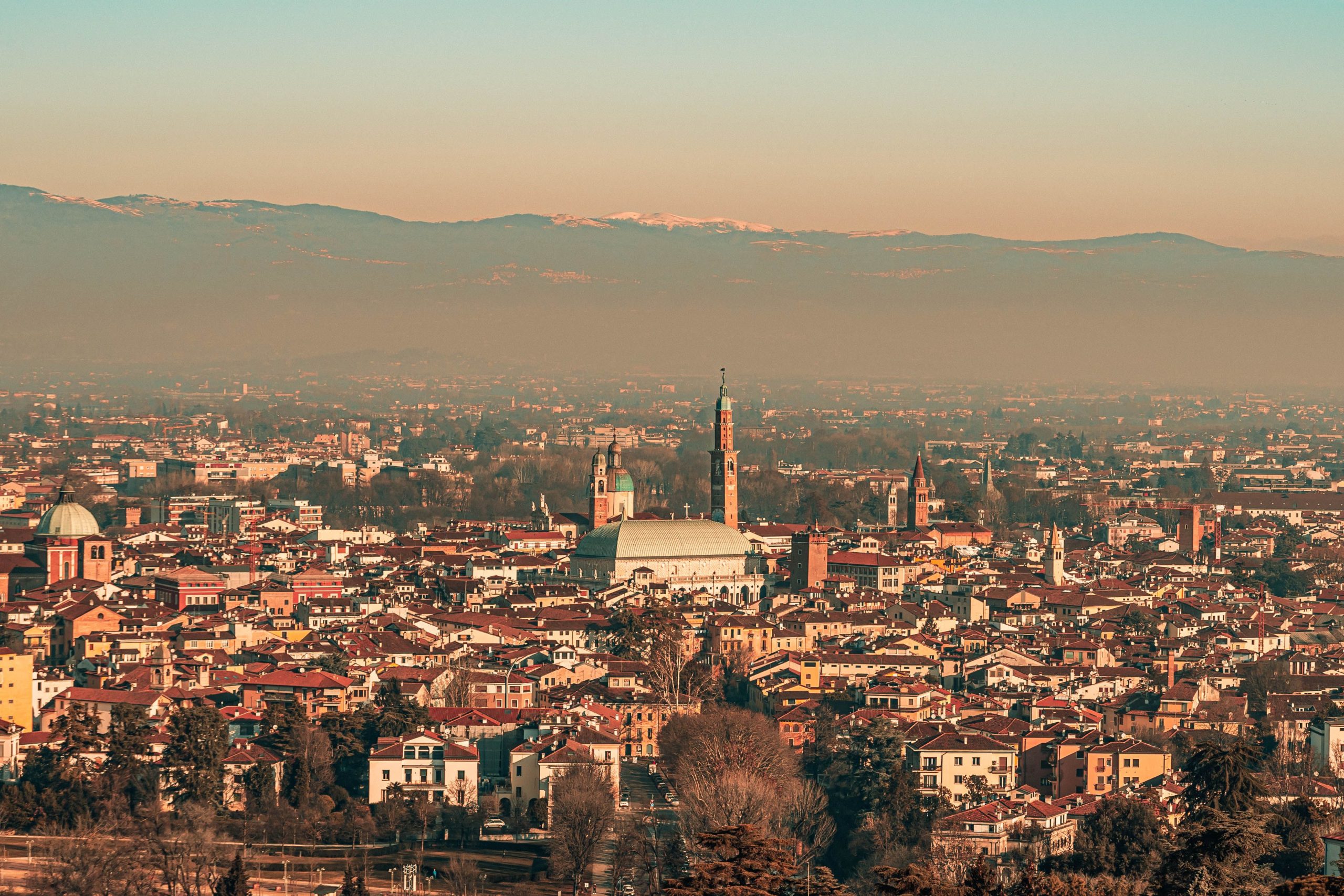
Vicenza doesn’t get the crowds of Venice or the fame of Verona, which is exactly why I like sending people here. It’s Palladio’s own city, and the architect whose work is scattered across Piazzola sul Brenta’s own Villa Contarini built his most theatrical work right in its center.
Here’s a detail most visitors don’t know: Andrea Palladio wasn’t actually born in “his” city. He was born in Padua in 1508, the son of a miller, and started out as a stonecutter’s apprentice there. At fifteen, he ran away to Vicenza – twice, the first attempt sent him back home – and it was here, in the workshop of local sculptors and builders, that he trained, found his patron Gian Giorgio Trissino (who gave him the name “Palladio”), and eventually designed nearly everything that makes the city what it is today: 23 of his works stand in Vicenza alone, part of why the city and the Palladian villas scattered across the Veneto were named a UNESCO World Heritage Site. He’s buried here too, in the Church of Santa Corona and later in a dedicated tomb at Vicenza’s main cemetery – a statue of him stands in Piazza della Ruota, right beside the Basilica Palladiana. Padua gave him his start; Vicenza is where he became Palladio.
The E27 bus runs directly from Piazzola sul Brenta to Vicenza, via Camisano, in about 39 minutes – and it drops you at Piazza Matteotti, right where the Teatro Olimpico is. It’s about as convenient a start as a day trip gets.
By car, the drive takes about 25-30 minutes; park at the edge of the historic center, since much of it is a restricted traffic zone anyway.
Step off the bus (or park nearby) at Piazza Matteotti and start with the Teatro Olimpico, the world’s oldest surviving indoor theater, completed in 1585 – single ticket €11 (reduced €8). Palazzo Chiericati sits right across the same square, home to Vicenza’s civic art collection from the medieval period to the 1800s – a single ticket is €5 (reduced €3.50), or cover both on a combined card (see Good to Know below).
Midday: Walk the length of Corso Palladio, Vicenza’s pedestrian main street, past palazzi Palladio himself designed – Palazzo Thiene and Casa Cogollo among them. A short detour off the Corso leads to the Church of Santa Corona, a Gothic church holding Giovanni Bellini’s Baptism of Christ and Palladio’s own burial place.
Lunch – the dish to order: Vicenza’s signature dish is baccalà alla vicentina – dried stockfish (not salt cod, despite the name) slow-cooked with onion, anchovies, milk, and olive oil until it turns almost creamy, traditionally served over soft polenta. Osteria Al Bacareto, in the historic center, does it properly, along with risotto with tastasàl (a local seasoned pork). It’s the kind of place locals actually eat at, not a tourist-menu trap.
Afternoon: Piazza dei Signori is home to the Basilica Palladiana, with its instantly recognizable double-tiered loggias – climb to the terrace if it’s open, and have a coffee at one of the bars underneath.
Late afternoon, if you’re visiting on a weekend: Villa Rotonda, one of Palladio’s most famous villas, sits just outside the center and is worth the short taxi ride or drive – though it’s typically only open to visitors on limited days, so check current hours before you go.
Evening: Wind down with an aperitivo on Corso Palladio before heading back to Piazzola sul Brenta.
Vicenza’s major sights are almost all run by the same civic museum circuit, which makes planning simple:
If you’re visiting three sites or more, the Vicenza SILVER Card (€16, valid 8 days, any 4 of 11 sites) or GOLD Card (€22, valid 8 days, all 11 sites) work out cheaper than paying individually – though Villa Rotonda, Villa Valmarana, the Cattedrale, and the Santuario di Monte Berico are never included on either card.
Beyond baccalà alla vicentina – the dish this city is actually known for – a few other things are worth ordering if you see them on a menu: risotto coi tastasàl, made with a loose, lightly spiced pork sausage that’s a Vicenza specialty in its own right; sopressa vicentina, a DOP cured pork salami you’ll find on almost any antipasto board in the province; and Asiago DOP, the cow’s-milk cheese from the plateau north of the city, sold both young and aged depending on what you’re after. None of it is trying to be fashionable – it’s the kind of food that’s been on the table here for generations, which is exactly the point.
After a day tracing Palladio's work across the city, it's a short bus ride back to sleep inside one of his legacy's own corners. Request availability to check availability.
Planning a trip to the Veneto? Don’t miss our day-trip guides to the region’s best cities – Venice, Padua, and Verona – each with a local’s itinerary, real prices, and honest tips on what to see and what to skip.
Boutique House alle Logge. A private stay inside the historic Palladian Loggias of Villa Contarini, in Piazzola sul Brenta.
© 2026 Palladian Villa. All rights reserved.
Roberta Zamberlan · Private host
CIR: 028063-LOC-00006
CIN: IT028063C2HZT6VFUH
We use necessary technologies to run this website and remember your preferences. With your permission, we also load external review content from Trustindex. You can reject optional services and still contact us or request availability. Change your choice at any time in the Cookie Policy.