
I grew up close enough to Verona that going “just for the day” was never a big deal – and that’s exactly the mindset I’d bring with you. Most first-time visitors try to see everything and end up seeing nothing properly. Here’s how I’d actually spend a day here, what I’d pay for, and the one attraction I think you can skip guilt-free.
Without a car, take the E074 bus to Padova (about 29 minutes, roughly hourly, Monday to Saturday – check the E021 on Sundays), then a train to Verona Porta Nuova – trains run every 20-30 minutes and take about 45 minutes, regional fares around €8-9. Budget about an hour and a half door to door.
By car, it’s a straighter shot at about 56 minutes via the A4.
If it’s your first time in the city, I’d actually recommend joining a free (tip-based) walking tour before doing anything else. A couple of hours with a local guide gives you the layout of the center and the stories behind the buildings, which makes the rest of your day click into place. Tours typically run 2 to 2.5 hours, departing daily from Piazza Bra near the Arena or from Arco dei Gavi, bookable through GuruWalk or Civitatis.
As of September 2026 it’s €33 for 24 hours or €38 for 48 hours, and includes free entry to the Arena, Juliet’s House (booking still required), both Basilicas (Santa Anastasia and San Zeno), Castelvecchio, Torre dei Lamberti, the Roman Theater Archaeological Museum, and several more, plus unlimited ATV city buses. It pays off if you’re planning to see four or more sites in a day – for just the Arena and one museum, paying separately is usually cheaper.
Morning: Start at the Arena di Verona – go early if you can, it’s a different building without the tour groups. Piazza Bra, right outside, is where everyone ends up for a coffee, though I’d walk a few streets away from the Arena for a better cup and a fairer price.
Then, Juliet’s House – my honest take:Yes, it’s manufactured. No, Juliet never lived there, and the museum inside is thin. But the courtyard is free, the balcony photo is a rite of passage, and half the fun is watching everyone else take the same photo you’re about to take. My advice: pop into the courtyard, skip the paid house unless you’re a completist, and don’t feel bad either way.
Midday: Walk to Piazza delle Erbe, the old Roman forum and still a market square today – mornings are best, while the stalls are setting up. Look up as you pass through the arch into Piazza dei Signori: there’s a whale bone hanging there that nobody has ever definitively explained. Piazza dei Signori itself has a statue of Dante and the Arche Scaligere, the Gothic tombs of Verona’s ruling family, just behind it.
Lunch – order the risotto: Head to La Taverna di Via Stella, a few steps from Juliet’s balcony, for risotto all’Amarone (around €15) – rice cooked in the region’s famous red wine, one of the dishes Verona actually built its food reputation on. For something more low-key, Osteria Caffè Monte Baldo near Piazza delle Erbe is a proper local spot with an honest wine list and cicchetti. Either way, skip anywhere with a laminated multilingual menu right on Piazza Bra or by Juliet’s House – those are priced for people who aren’t coming back.
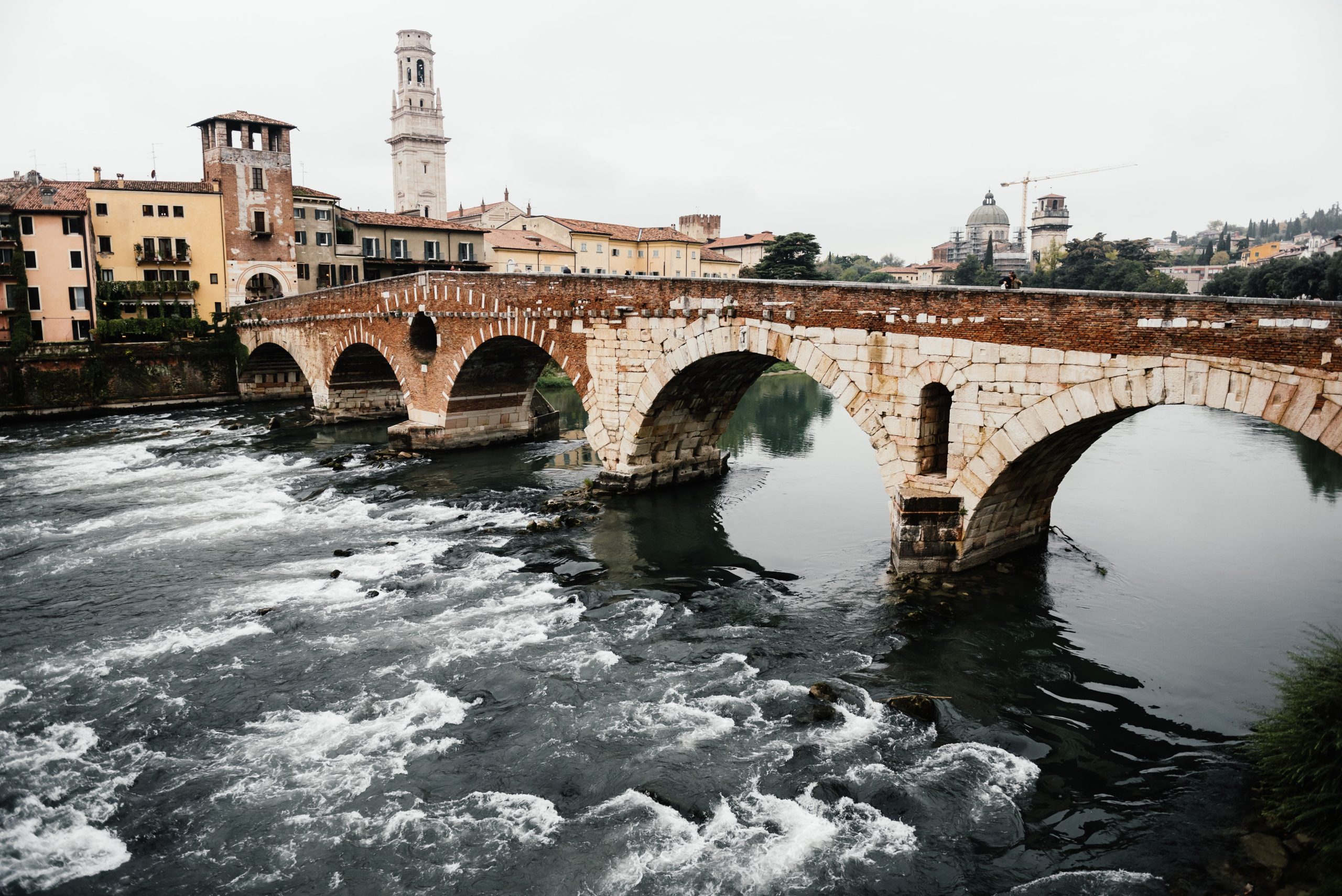
Afternoon: Climb (or take the lift up) Torre dei Lamberti for the best rooftop view in the center. Then head to Castelvecchio and cross the Ponte Scaligero beside it – the castle’s red-brick medieval bridge, rebuilt after the Second World War using as much of the original brick as they could recover. Cross the river and walk along it to Ponte Pietra, Verona’s oldest bridge, with the hills and the Roman Theater just beyond.
Evening – the part locals actually care about: Climb up to Castel San Pietro for sunset. This is the view I send people to, not the tower in the center – the whole city, the river, and the rooftops laid out below you, and far fewer people than you’d expect for the best vantage point in Verona. Walk up the stairs from near Ponte Pietra, or take the funicular if you’d rather save your legs (not included on the VeronaCard).
Beyond the risotto all’Amarone, a few dishes are worth ordering if you see them: gnocchi di patate, tied to a Carnival tradition dating back to a 1531 famine, when a local doctor had flour, butter, and cheese handed out to the hungry the Friday before Lent; lesso con la pearà, boiled beef served with a peppery bread-and-broth sauce that legend traces back to a Lombard queen; pastissada de caval, a slow-braised horse meat stew with red wine and onions, always served with polenta; and tortellini di Valeggio, thin pasta parcels of meat, cheese, and nutmeg from the town of Valeggio sul Mincio nearby. If you’re here in December, Verona is also the birthplace of pandoro – worth a slice with mascarpone cream if you’re visiting around Christmas.
Wear shoes you don’t mind walking in – Verona looks compact on a map, but a full day here easily adds up to several kilometers of cobblestones. Via Sottoriva, a quiet arcaded medieval street, is one of the best areas for an evening trattoria away from the main tourist flow.
After a day tracing Palladio's work across the city, it's a short bus ride back to sleep inside one of his legacy's own corners. Request availability to check availability.
Planning a trip to the Veneto? Don’t miss our day-trip guides to the region’s best cities – Venice, Padua, and Vicenza – each with a local’s itinerary, real prices, and honest tips on what to see and what to skip.

Boutique House alle Logge. A private stay inside the historic Palladian Loggias of Villa Contarini, in Piazzola sul Brenta.
© 2026 Palladian Villa. All rights reserved.
Roberta Zamberlan · Private host
CIR: 028063-LOC-00006
CIN: IT028063C2HZT6VFUH
We use necessary technologies to run this website and remember your preferences. With your permission, we also load external review content from Trustindex. You can reject optional services and still contact us or request availability. Change your choice at any time in the Cookie Policy.